|
Aspects
In an Astrology Chart, the planets have an additional dimension. Their geometric angles to each other also influence your personality. Astrologers look at the inter-relationship of the planets to understand how planets work with, or against, each other. As in life, some relationships require more attention than others.
Aspects represent stresses, tensions, and harmonious relationships between the different parts of your life. A challenging aspect between two planets can motivate you to accomplish great things in life, or you can hide under the covers. Harmonious aspects can help you to express life creatively; or, you can get lazy because the planets involved flow so easily that you decide to just kick back and do nothing. All astrology charts have a combination of challenging and harmonious aspects.
Many people tend to judge the challenges in their astrology chart. Remember that you chose to be born into this life because the conditions were perfect for your soul to experience what it needed to learn. It is your choice to accept the opportunity or to hide under the covers. Your chart is a map of the challenges you brought into this life, and the set of talents you gave yourself to overcome those challenges. The inter-relating aspects in a chart help you to integrate the challenges and the talents.
|
|
Conjunctions |

|

|
|
 When two or more planets are aligned exactly next to, or very close to, each other in your chart are said to be “conjunct.” Astrologers like to go to conferences and discuss how close is close enough to be called a conjunction. The range of how far an aspect is away from exact is called an “orb of influence". Common orbs range from 2-10 degrees depending upon the astrologer, the aspect, and the planets involved. If you are in a relationship with a person whose birthday is within ten days of your own, you could say that your suns are conjunct. When two or more planets are aligned exactly next to, or very close to, each other in your chart are said to be “conjunct.” Astrologers like to go to conferences and discuss how close is close enough to be called a conjunction. The range of how far an aspect is away from exact is called an “orb of influence". Common orbs range from 2-10 degrees depending upon the astrologer, the aspect, and the planets involved. If you are in a relationship with a person whose birthday is within ten days of your own, you could say that your suns are conjunct.
A conjunction means that the planets involved affect each other very strongly, usually blending and assisting each other. It is a natural place of connection where two or more planets act as one. They become integrated. Depending upon the planets involved, this integration may come naturally to you, or it could be a life-long practice if the planets challenge each other. The New Moon is an example of a conjunction. This is the dark phase of the moon when the Sun and Moon are in alignment. An example would be when you have a strong friendship with someone; then, she or he goes away for a while. When she or he returns, you plug right back into the friendship like time has stood still. That is an example of how a conjunction feels.
|
|
Squares |
|
|
|
 Planets at a 90-degree angle from each other are said to be Square. Imagine a hurdle in a track meet. You are motivated to get over the hurdle, but it takes extra planning and effort. A square ties two or more planets together in such a way that they are challenged to work together. This challenge often manifests as tension and stress. However, people who learn how to work with the difficult aspects of their chart often accomplish more that those who have charts filled with easy aspects. Signs that are square to each other: 1) action oriented signs- Aries, Cancer, Libra, and Capricorn; 2) persevering signs- Taurus, Leo, Scorpio, and Aquarius; 3) adaptable signs- Gemini, Virgo, Sagittarius, and Pisces. Planets at a 90-degree angle from each other are said to be Square. Imagine a hurdle in a track meet. You are motivated to get over the hurdle, but it takes extra planning and effort. A square ties two or more planets together in such a way that they are challenged to work together. This challenge often manifests as tension and stress. However, people who learn how to work with the difficult aspects of their chart often accomplish more that those who have charts filled with easy aspects. Signs that are square to each other: 1) action oriented signs- Aries, Cancer, Libra, and Capricorn; 2) persevering signs- Taurus, Leo, Scorpio, and Aquarius; 3) adaptable signs- Gemini, Virgo, Sagittarius, and Pisces.
|
|
Trines |
|
|
|
 Planets that are 120 degrees apart from each other are said to be in a trine. When you divide a circle by three, you get a shape that looks like a triangle, hence the term trine. Harmony and flow are characteristics of the trine. The most common form of trine is between planets that are in the same element: 1) Water signs are Cancer, Scorpio, and Pisces; 2) Earth signs are Taurus, Virgo, Capricorn; 3) Fire signs are Aries, Leo, and Sagittarius; 4) Air signs are Gemini, Libra, and Aquarius. A relationship between the Sun in Pisces and the Moon in Cancer would be called a trine. The basic vitality of the life force-giving Sun would be in harmony with the emotions of the Moon. Astrologers like to be specific about the exactness of what is called a trine, so they look to see how close two planets are to 120 degrees apart before they call it a trine. Planets that are 120 degrees apart from each other are said to be in a trine. When you divide a circle by three, you get a shape that looks like a triangle, hence the term trine. Harmony and flow are characteristics of the trine. The most common form of trine is between planets that are in the same element: 1) Water signs are Cancer, Scorpio, and Pisces; 2) Earth signs are Taurus, Virgo, Capricorn; 3) Fire signs are Aries, Leo, and Sagittarius; 4) Air signs are Gemini, Libra, and Aquarius. A relationship between the Sun in Pisces and the Moon in Cancer would be called a trine. The basic vitality of the life force-giving Sun would be in harmony with the emotions of the Moon. Astrologers like to be specific about the exactness of what is called a trine, so they look to see how close two planets are to 120 degrees apart before they call it a trine.
|
|
Quincunxes and Yods |
|
|
|
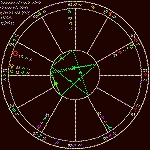 A quincunx is when two planets are 150 degrees apart. Alone, a quincunx is a relatively weak aspect, but has difficult tendencies because of the signs they connect. A quincunx is when two planets are 150 degrees apart. Alone, a quincunx is a relatively weak aspect, but has difficult tendencies because of the signs they connect.
A Yod occurs when two planets in sextile (60° apart) both form an inconjunct (a 150° angle) with a third planet. The third planet in the inconjunct represents the action point of the Yod; the mid point between the other two planets is the reaction point. The action point of the configuration is sometimes called the "finger of God," and the finger formed by the two inconjuncts points to a place in your chart likely to be very active. The Yod is believed by many astrologers to be a karmic configuration, and it suggests that there is a compulsive "debt" repayment associated with the area of the chart pointed out.--from astrology numerology.com
|
|
Unaspected Planets |
|
|
|
Occasionally, you will see a planet that is not aspected by another planet. This means that the major aspects listed above (and planets not in a parallel/contra parallel relationship- a term having to do with their north-south latitude positioning, known as declination) are not aspected with another planet. It is almost as if that planet does not know how to relate in the world. A person with an Unaspected planet must learn to integrate the nature of that planet into their life. An example of an Unaspected Venus is a person who seems to have this magnetic charm and beauty, yet is oblivious to the reaction they receive from people who are attracted to them.
|
|
Other Aspects |
|
|
|
There are numerous minor aspects used by astrologers. A Semi-square (45 degrees), a Sesquiquadrate (135 degrees) and an Inconjunction (150 degrees) are considered to have some stress associated with them. Dividing a circle by five creates a 72-degree aspect called a Quintile. This is considered to be a subtle, but highly creative, aspect. A Septile divides the circle by seven (51 3/7 degrees) and is thought to have karmic implications in a chart.
|
|
About |
|
|
|
Mark Dodich has been providing astrology and intuitive consultations since 1980. He holds a certificate as a Certified Astrological Professional (CAP). Mark provides consultations internationally from his office in Portland, Oregon. Mark is past president of the Oregon Astrological Association, is viewed regularly in the media, and publishes his own newsletter, ASTROMARK. He can be reached at
This e-mail address is being protected from spam bots, you need JavaScript enabled to view it
or check out his website at http://www.astromark.us/.
|
|
|
|


 When planets fall exactly across the circle (180 degrees apart) of the chart from each other, they are said to be opposite each other. An opposition is like a tug-of-war where two sides pull for equal attention. Although you will initially feel pulled apart, the purpose is to provide a greater life perspective based upon the nature of the two planets. The goal is to integrate the two planets so they can work together in a better way than they work individually. Every Full Moon is an opposition of the Sun and Moon. A full moon is highly expressive where people tend to act out. Inner behavior patterns express themselves outwardly so that we can see what is going on at deeper levels.
 A mini-trine is called a sextile. Measuring 60 degrees apart, a sextile represents planets that are two signs away from each other. This is also a harmonious relationship between planets, but not quite as strong as a trine. You need to consciously pay attention to the two planets involved in a sextile in order to get the most benefit from them. For example, many people who were born in the late 1940’s and early 1950’s had Neptune in Libra sextile Pluto in Leo, meaning that Neptune was two signs away from Pluto and within an orb of influence that was near 60 degrees apart. Ultimately, this sextile heled an entire generation to open to higher ideals.

