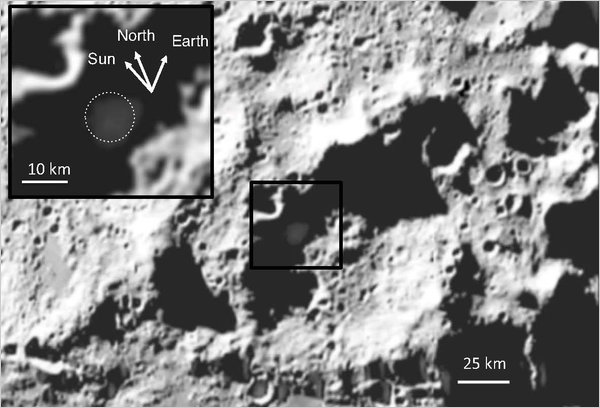
 The Moon, at least at the bottom of a deep, dark cold crater near its south pole, seems to be wetter than the Sahara, scientists reported Thursday.
In lunar terms, that is an oasis, surprisingly wet for a place that had long been thought by many planetary scientists to be utterly dry.
If astronauts were to visit this crater, they might be able to use eight wheelbarrows of soil to melt 10 to 13 gallons of water. The water, if purified, could be used for drinking, or broken apart into hydrogen and oxygen for rocket fuel — to get home or travel to Mars.
“That is a very valuable resource,” said Anthony Colaprete, principal investigator of NASA’s Lunar Crater Observation and Sensing Satellite — or Lcross, for short — which made the observations as it, by design, slammed into the Moon a year ago. “This is wetter than some places on Earth.”
The Sahara sands are 2 to 5 percent water, and the water is tightly bound to the minerals. In the lunar crater, which lies in perpetual darkness, the water is in the form of almost pure ice grains mixed in with the rest of the soil, and is easy to extract. The ice is about 5.6 percent of the mixture, and possibly as high as 8.5 percent of it, Dr. Colaprete said.
“That is a large number, larger than I think anyone was anticipating,” Dr. Colaprete said.
The $79 million Lcross mission piggybacked on the Lunar Reconnaissance
Orbiter, which was launched in June last year and has been mapping out
the lunar surface for a future return by astronauts. Lcross steered the
empty second stage of the rocket, which otherwise would have just burned
up in the Earth’s atmosphere, onto a collision course with the Moon.
Last October, as it neared impact, the Lcross spacecraft released the
empty second stage and slowed down slightly so that it could watch the
stage’s 5,600-mile-per-hour crash into a 60-mile-wide, 2-mile-deep
crater named Cabeus. A few minutes later, Lcross, quickly transmitting
its gathered data to Earth, met a similar demise.
For people who watched the live Webcast video transmitted by Lcross, the
event was a disappointment, with no visible plume from the impacts. But
as they analyzed the data, scientists found everything they were
looking for, and more. Last November, the team reported that the impact
had kicked up at least 26 gallons of water, confirming suspicions of ice
in the craters.
The new results increase the water estimate to about 40 gallons, and by
estimating by amount of dirt excavated by the impact, calculated the
concentration of water for the first time.
Also surprising was the cornucopia of other elements and molecules that Lcross scooped out of the Cabeus crater, near the Moon’s south pole. Lying in perpetual darkness, the bottom of Cabeus, at minus 370 degrees Fahrenheit, is among the coldest places in the solar system and acts as a “cold trap,” collecting a history of impacts and debris over perhaps a couple of billion years.
“This is quite a reservoir of our cosmic climate,” said Peter H. Schultz, a professor of geological sciences at Brown University and lead author of one of the Science papers. “It reflects things that hit the Moon.”
By analyzing the spectrum of infrared light reflected off the debris plume, Dr. Schultz and his colleagues identified elements like sodium and silver.
Instruments on the Lunar Reconnaissance Orbiter, also watching the impact, identified other compounds, like calcium, magnesium and mercury.
With the multitude of minerals, scientists can examine the relative abundances and start speculating about what sorts of objects have been hitting the Moon. Some material looks very similar to what is found in comets. Other minerals look like what is produced by chemical reactions that occur on very cold surfaces.
“What’s really exciting to me is that Cabeus could be a comet impact site,” Dr. Colaprete said.
Lcross and the lunar orbiter are part of NASA’s Constellation program, started five years ago by the Bush administration to send astronauts back to the Moon. Arguing that it is too expensive and that the United States has already been there, President Obama has pushed for its cancellation. A compromise on the space agency’s future, passed by Congress and signed into law by Mr. Obama last week, sets aside Moon ambitions for now, at least for the return of human explorers.
Dr. Schultz hopes that study of the Moon will continue.
“I think the poles have just opened up a flurry of new questions,” he said. “I think it is a destiny that we will go there as humans. I hope it’s not just for commercialization.”