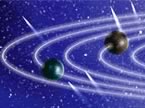
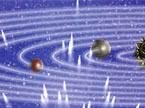
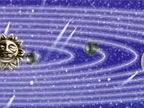
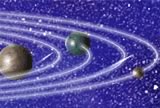
The big news of the month concerns Mars. I’ve been asking you keep your eye on Mars for a few months now in preparation for this historical event and this month provides the culmination you’ve been waiting for! On August 27 at 5:51am EDT, Mars passes 34,646,418 miles from Earth. This is the closest he has been in almost 60,000 years! Approximately every two years and one and a half months, the Earth passes Mars since Earth is on the inner orbital track around the Sun. Mars takes a bit less than two Earth years to orbit the Sun. The additional time to 25.5 months is what it takes Earth to catch up to Mars’ additional movement. (This is much like how the Moon must move further than 360* to have a New Moon again, as it has to catch up to the additional geocentrically apparent monthly movement of the Sun.) As Earth approaches Mars, passing in our respective orbits, Mars appears to slow down from our geocentric point of view and then move backwards as we pull forward, passing him up. This phenomenon accounts for the regular occurrence of Mars’ retrograde. (It accounts for the regular occurrence of all the outer planets’ retrogradation as well.) Mars went retrograde on July 29th and will station direct on September 27th. Notice the closest we come is at the midpoint of the retrograde period.
There is yet another dimension to explore in regards to how close the Earth and Mars are in their passage. As Mars and the Earth both orbit the Sun in elliptical paths rather than circular paths, there are times when the two orbits are closer to each other and times when they are farther. In this current retrograde period of Mars the two are passing at the closest point possible between the two elliptical paths. This means that in our night skies Mars will appear bigger and brighter than we have ever seen him in recorded history and will ever again for centuries to come. Certainly you won’t want to miss witnessing this rare event!
At the beginning of the month in the northern hemisphere Mars rises above the eastern horizon at about 10:30 p.m. amongst the stars of the constellation Aquarius. This is his sidereal position against the backdrop of the fixed stars. He will make his way almost completely across the sky until the glow of dawn will have him fading from view in the western sky before we can witness his setting. By mid-month Mars rises around 9:15 p.m. and the Sun will rise before he sets into the western horizon. On the 28th, Mars opposes the Sun, meaning he will rise in the east as the Sun sets in the west. Therefore he will be visible for his entire trek across the sky where he’ll set in the west as the Sun rises in the east as well. On the 30th, Mars reaches perihelion to the Sun, the closest distance he comes in his elliptical orbit to the Sun. The combination of the opposition and the perihelion to the Sun also plays into Mars close passage and his size and brightness in our night sky. Mars will double in brightness this month and appear much larger on the 27th than he does on the 1st. There is a map of Mars on the 27th at 5:51 a.m. EDT in the OCA public library http://www.astrocollege.com/campus/libraries.cgi denoting his position low in the western sky at the time of the culmination of this event, though it may be better to catch him earlier on when he is higher in the sky. Remember that we have 24 hours in a day and 12 signs of the zodiac, meaning a new sign rises approximately every two hours and also that Earth’s spin on her axis turns the sky about 15 degrees every hour. That handy rule of thumb can enable you to predict Mars position from the map at the time you choose to observe him, though signs of short and long ascension cause a slight variable in this simplified method.
For those viewing from Australian skies, Mars rises above the eastern horizon around 9:00 p.m. at the beginning of the month. Daylight will encroach to blot out his magnitude before he sets in the west. By mid-month he will rise about 8:00 p.m. The opposition of Sun-Mars occurring on the 29th at 3:51 a.m. AEST will keep him visible all night long. By month’s end he will rise around 7:00 p.m. A map of Mars on the 27th at 7:51 p.m. AEST when this event culminates is available in the OCA Public Library http://www.astrocollege.com/campus/libraries.cgi though you may have better viewing conditions a bit later as Mars rises higher into the evening sky. Mars will be beautifully visible in the west around 10:00 p.m.
Saturn and Mercury are also visible this month. Venus and Jupiter are both under the suns’ beams as their conjunctions with the Sun occur on the 18th and 22nd respectively. Interesting that the only planets capable of outshining Mars at his highest recorded magnitude have left the stage for his historical performance. However it may be possible to catch a brief glimpse of Jupiter very low along the western horizon for a few minutes as twilight encroaches at sunset during the first few days of August.
Mercury reaches greatest eastern elongation on the 14th; this means he is visible as an evening star for about a week prior and after. He is visible in the western sky after sunset for about almost an hour after the Sun disappears into the western horizon. This time of year does not provide the best viewing conditions for Mercury, though. It is because of the lowness of the Ecliptic in the northern hemisphere’s summer time, and the city lights will likely dampen, if not entirely blot out, his view.
In the southern hemisphere, however, the angle of the Ecliptic is more perpendicular, enabling a more opportune observation of Mercury. For Australian observers, Mercury’s greatest eastern elongation from the Sun occurs much higher in the sky than for United States observers, due to the position of the Ecliptic. Therefore city lights will not dampen his view, and the window of viewing time increases to greater than an hour and a half after sunset. A map of Mercury on August 14th at 8:00pm AEST is available in the OCA Public Library. http://www.astrocollege.com/campus/libraries.cgi
Saturn rises around 4:15 a.m. in the northern hemisphere at the beginning of August. He will rise around 3:30 a.m. by mid month and around 2:30 a.m. by month’s end. Saturn is currently located amongst the fixed stars of the constellation Gemini. He will disappear from view as the glow of dawn encroaches at sunrise before he reaches his culmination point in the sky. The culmination point of a planet is when it reaches the “high noon” position, which occurs at the intersection of the Prime Meridian and Ecliptic. Saturn will not reach that height in the nighttime viewing hours, for dawn will be upon us before then. A map of Saturn on the 23rd in the morning hours of 5:30 a.m. for the northern hemisphere is available in the OCA Public Library. http://www.astrocollege.com/campus/libraries.cgi
For those in the southern hemisphere, Saturn rises around 6:45 a.m. at the beginning of August. By mid month he will rise around 6:00 a.m. By month’s end he rises around 5:00 a.m. He will be visible in the eastern sky until the glow of dawn dampens his view at sunrise.
A First Quarter Moon occurs on the 5th at 3:29 a.m. EDT. The Full Moon occurs on the 12th at 12:48 a.m. EDT. On this day, she will rise ahead of Mars as she approaches conjunction with him. On the 13th the Moon rises just after Mars and will trek across the night sky with him. This is the same for the north and south hemispheres. The Third Quarter Moon occurs on the 19th at 8:48 p.m. EDT. On the 23rd a slender balsamic sliver of a Moon hangs above Saturn in both the northern and southern hemisphere’s early morning sky. She will dance on past by the morning of the 24th. The New Moon occurs on the 27th at 1:26 p.m. EDT. On the same day, approximately 7.5 hours later, Mars will reach his closest proximity to Earth,.
The Perseid Meteor Shower peaks this month on the 13th, but the light from the Full Moon will dampen the numbers of visible shooting stars. For those in the northern hemisphere, use the map of Saturn to locate Perseus, the constellation from which the radients stem. Though the constellation of Perseus is off the map, it is located directly above Auriga, which makes the map. It is the foot of Perseus you see emerging from the top of the map. For observers in the southern hemisphere, Perseus will rise with Saturn. Saturn is in the constellation Gemini rising in the NE. Perseus will rise at the same time as Gemini, but will be 2 constellations away along the horizon [with Auriga in between] rising almost due north.
Happy Star Gazing! Feel free to pass Sky Watch along to your friends and family, as no one should miss this month’s unique phenomenon of Mars.
Happy stargazing!
Julene M. Johnson, NCGR-III
Media Director, OCA
Instructor, OCA
ONLINE College of Astrology www.astrocollege.com FIRST in Online Astrological Education